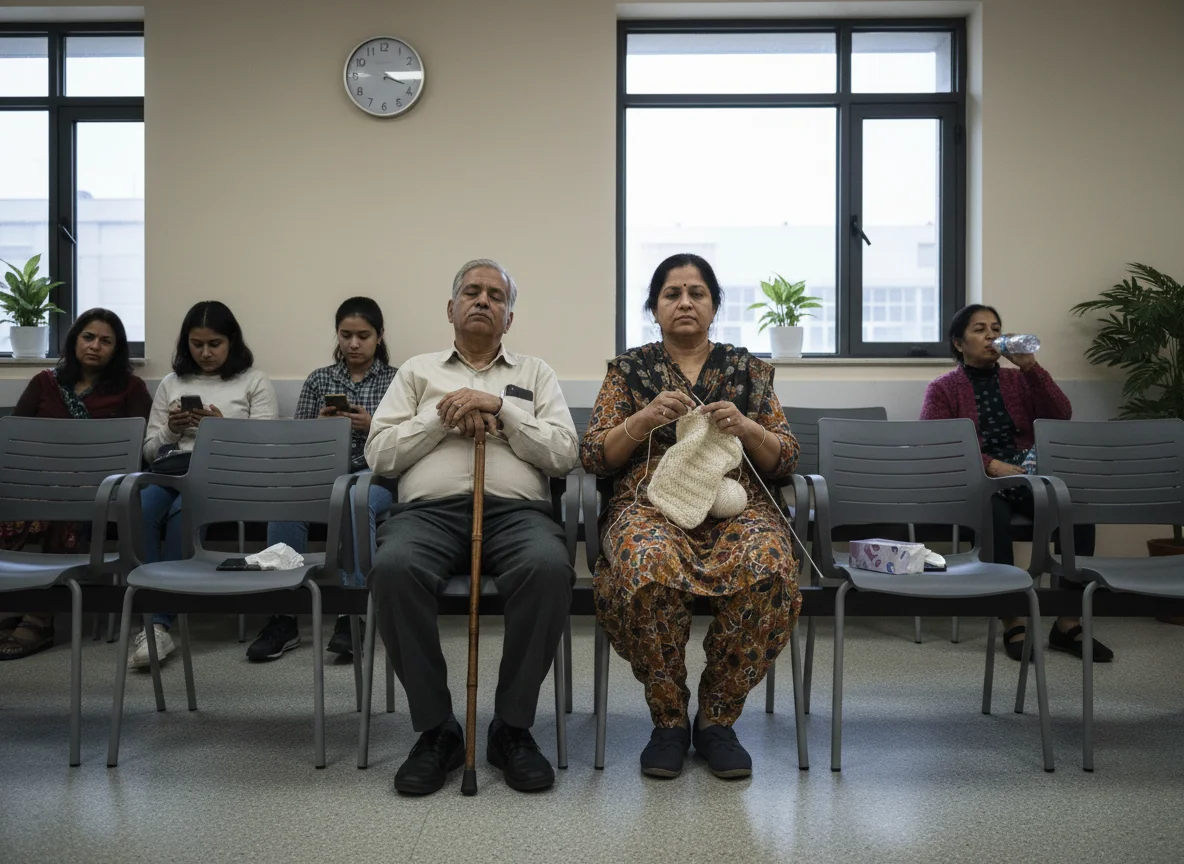
Take a moment to study the picture. Notice the people, the place, and what is happening.
What happens next
5 guided steps — we upgrade one simple line, layer by layer.
Noun → Detail → Action → How → Link — the formula we follow.
Read together — each step adds a new part to the sentence.
Record & listen — hear yourself and check how you read.
Final steps — combine the full scene, then say what it shows.
1
2
3
4
5
6
✓
Step 1
Identify the nouns
Who and what do you see? Name the main people, objects, and places before we build a sentence together.
For this picture
peoplemanwomanchairsroomclock
Step 2
Add details (adjectives)
Make each noun more vivid. Ask: What kind of?How old?What colour?
Upgrade the nouns
peopleseveral waiting people
manan elderly man
womana middle-aged woman
chairsgrey plastic chairs
rooma plain waiting room
clocka round wall clock
Step 3
Add action (verbs)
What is happening right now? Use strong verbs — not just is.
Actions in this scene
waitrestsknitsusesdrinks
Step 4
Say how (adverbs)
How is the action done? Adverbs and phrases like with difficulty add realism.
How it happens here
patientlycalmly on his canediligentlysilently on their phonesslowly
Step 5
Link — feeling & meaning
This closes your paragraph. What struggle, mood, or human story does the image show?
Deeper links
The long wait requires patience and resilience.
Family members offer quiet support to each other.
The atmosphere suggests hope and quiet anticipation.
Step 6
Combine everything
Read the full scene description aloud — every layer we built together.
Model sentence
In a plain waiting room, several patient people sit on grey plastic chairs; an elderly man calmly rests on his cane, a middle-aged woman diligently knits, and young girls silently use their phones or slowly drink from a bottle, all beneath a round wall clock.
Final
Go one step further — what does it show?
What emotions, trust, or human story does this image reveal?
Meaning & feeling
This scene captures the universal experience of waiting in a hospital, often filled with quiet contemplation and subdued emotions. It highlights the diverse ways people cope with long waits, from purposeful activity like knitting to passive engagement with phones. Despite the stillness, there is a strong sense of shared human experience and silent endurance.
Listen
Read together
People sit in a room.
Tap Record, read the sentence, then Listen to hear yourself. Your voice is saved for this step only — we do not write down what you say.
Scene 507
Hospital Waiting Rooms · Hospital Waiting Rooms
Notice
You have new notices
Please review and acknowledge the messages below.
Interview
Choose how you want to prepare — career-focused or exam-style speaking.